We get called to look at failed floors regularly. Almost all of them fall into four categories, and the first one accounts for more failures in central Kentucky than the other three combined.
1. Moisture vapour drive — the Bluegrass problem
Concrete is porous, and water vapour moves through it continuously from the wetter side toward the drier side. Seal the top with a coating and that vapour reaches the underside of the film with nowhere to go. Pressure builds until it lifts the coating in blisters, or debonds it in sheets.
Central Kentucky produces more of this than almost anywhere we work, for reasons that stack on top of each other:
- Rainfall. Roughly 45 inches a year, spread across every season rather than concentrated in a wet period.
- Karst geology. The limestone under the Bluegrass is riddled with fractures and solution channels, so groundwater moves laterally in ways that are genuinely hard to predict. A slab can sit dry for years and then take moisture after a change in drainage nearby.
- High water table. Common across the region, and it puts the underside of a slab much closer to saturated ground than most contractors assume.
- At-grade and partly below-grade garages. Kentucky's rolling terrain means a great many attached garages are cut into a slope, with soil against one or more walls.
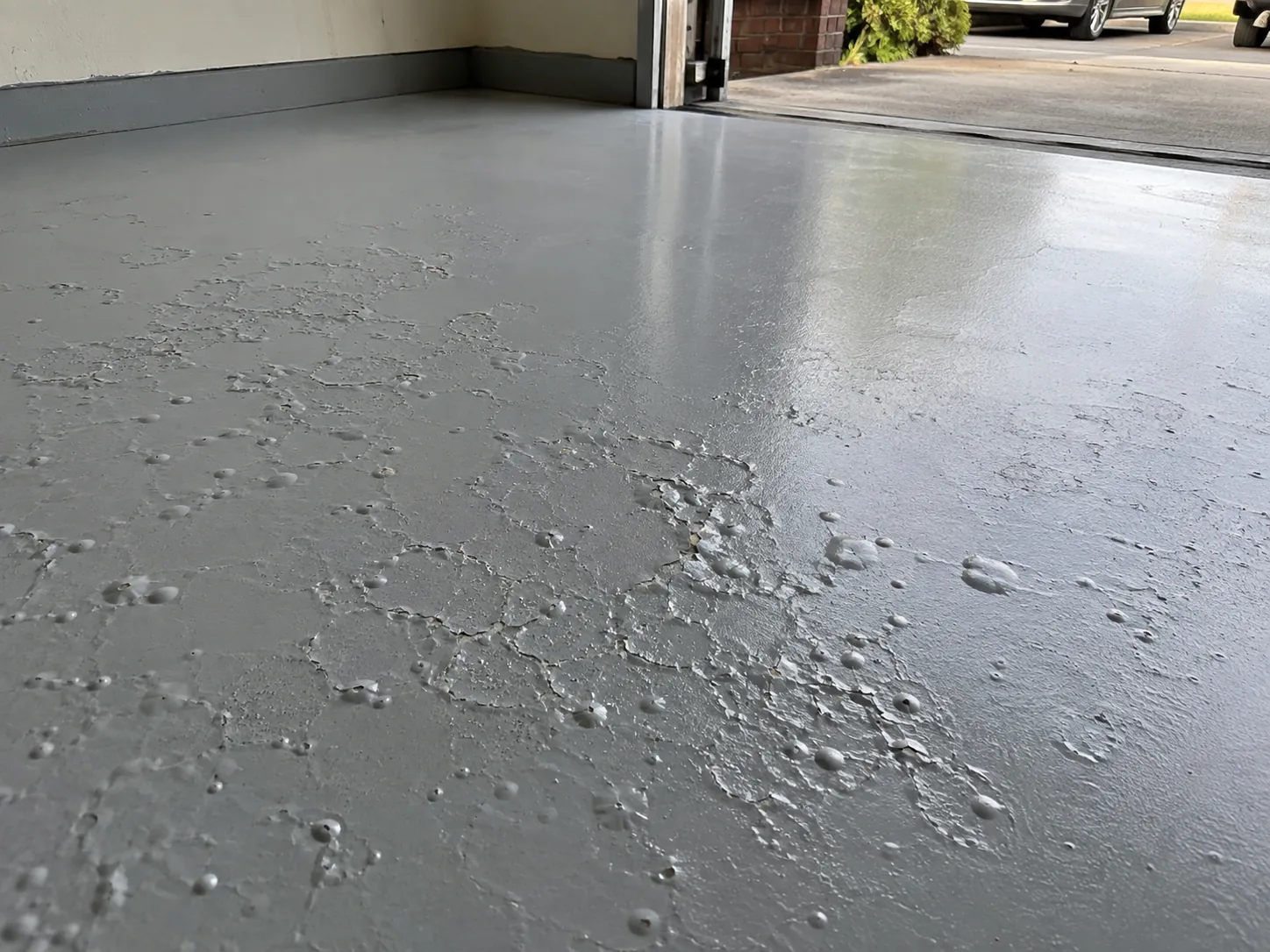
How to avoid it. Test the slab before anyone quotes a coating — a calcium chloride test to ASTM F1869 or, better, relative humidity probes to ASTM F2170. Then use a moisture-mitigating primer if the numbers call for it. This is not optional here, and it is the single biggest thing separating a Lexington floor that lasts from one that does not. Full detail on moisture testing and vapour barriers.
A contractor who quotes your floor without testing the slab is transferring that risk onto you. Most coating warranties exclude substrate moisture — which means if it blisters in eighteen months, the conversation will be about whether the slab was suitable, and nobody can answer that after the fact if it was never measured.
2. Summer humidity and amine blush
Kentucky summers run genuinely humid, with dew points sitting in the seventies for weeks. When epoxy cures in those conditions, unreacted amine in the hardener reacts with airborne moisture and carbon dioxide to form a waxy film on the surface — amine blush.
The trouble is that blush is close to invisible. The floor looks fine. But the next coat cannot bond through it, so you end up with a topcoat sitting on a greasy layer instead of keyed to the coat below. It peels months later, cleanly, with no obvious cause.
How to avoid it. Track dew point rather than relative humidity, do not apply when the slab is within about five degrees of it, and wash between coats if there is any doubt. It is also a strong argument for polyaspartic, which is far less prone to blushing.
3. Road salt and freeze-thaw
Kentucky winters are milder than the plains, but that is not entirely good news. Lexington sits right around the freezing line for much of the winter, which means the slab crosses it repeatedly rather than staying frozen. Water in the top few millimetres of concrete freezes, expands roughly nine percent, and prises the surface apart — and it happens over and over.
Add the salt and brine that come home from Man o' War and New Circle after a treatment run, and you have chloride sitting in meltwater on your slab. It attacks bare concrete directly and creeps under any coating with a weak edge.
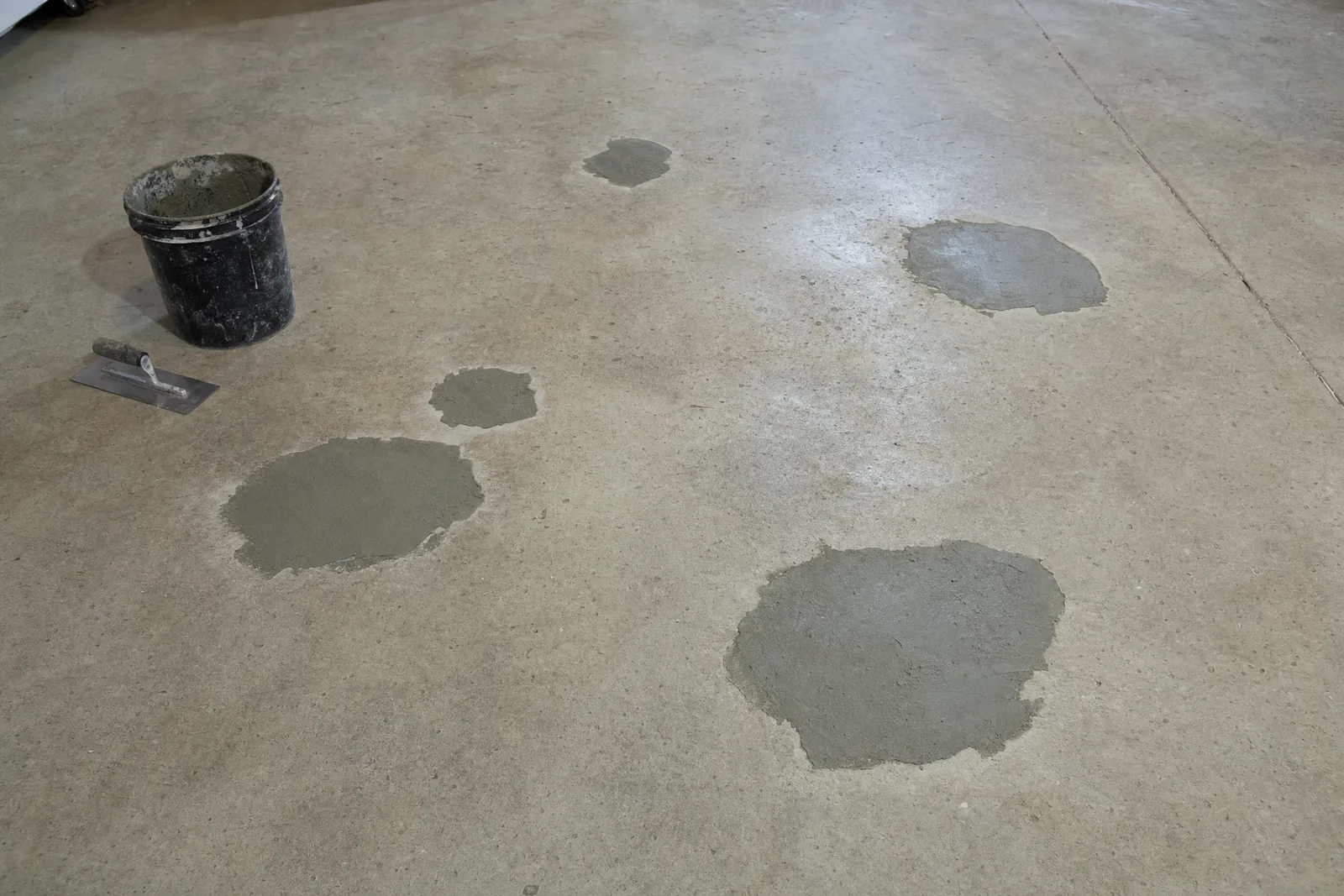
How to avoid it. A properly ground perimeter, a thick clean termination at the threshold, and spall repair cut back to sound concrete rather than coated over. Rinse the floor a few times across the winter.
4. Green slabs on new construction
Concrete needs roughly 28 days before it can take a coating — it is still releasing mix water and the surface has not reached full strength. Across the growth corridors around Nicholasville, Georgetown and Hamburg, that window gets compressed, sometimes by builder-arranged contractors working to a completion date rather than to the concrete's schedule.
How to avoid it. Get the pour date in writing. If nobody can produce it, test the slab rather than guessing.
Two failures that are not climate related
Perimeter delamination
The floor looks perfect across the open field and is lifting along the walls. A walk-behind grinder cannot reach the last inch or two, and hand grinding that perimeter is slow, uncomfortable work. Skip it and you have unprepared concrete exactly where water and cleaning solution collect.
Off-ratio material
Two-part resins cure by chemical reaction and the mix ratio is not approximate. Material mixed by eye never fully cross-links. It stays softer than specification indefinitely, which compounds every other problem on this page.
What a failure timeline usually looks like
| When it shows | Most likely cause |
|---|---|
| Days to weeks | Off-ratio mix, or applied over a visibly wet or contaminated slab |
| 3–12 months | Amine blush between coats, or inadequate surface profile |
| 6–24 months | Moisture vapour drive — the classic Lexington failure |
| First or second winter | Salt working under a weak edge or threshold |
| Seasonally, worse in spring | Groundwater changes reaching the slab |
| 10+ years | Normal wear. This is a recoat, not a failure |
Diagnosing your own floor
| What you see | Most likely cause |
|---|---|
| Round raised bubbles across the open field | Moisture vapour drive |
| Large sheets lifting cleanly, smooth concrete underneath | Amine blush, or no mechanical profile |
| Worse in spring, better in late summer | Seasonal groundwater |
| Lifting at the threshold and creeping inward | Chloride attack under a weak edge |
| Pitted, crumbling concrete at the door | Freeze-thaw damage to the slab itself |
| Coating gone at the perimeter only | Edges never ground |
| Failed within a year of a new build | Coated before the slab had cured |
Send us a photo and we'll tell you which of these you're looking at, whether or not you hire us. The diagnosis is usually obvious to someone who sees these weekly, and it changes what you should be asking other contractors.
If your floor is failing now
- Photograph it — wide shot plus close-ups of the failure edge.
- Note the season. If it started or worsened in spring, that points hard at moisture.
- Find your paperwork. If it is under five years old there may be a live warranty, and that conversation should happen before you pay anyone else.
- Do not coat over it. A moisture failure recoated without mitigation blisters again, and you will have paid twice.
The uncomfortable summary
Almost none of these are product failures. The coatings sold today are excellent, and even mid-tier products perform well when installed correctly. What fails is process — and in this market, overwhelmingly, it is the slab never having been tested.
That is genuinely good news for you as a buyer, because it means one question predicts most of the outcome: what did the moisture test read?
Two failure modes that are not climate related
The four above are the Lexington-specific ones. Two more account for most of what remains, and they are pure workmanship.
Perimeter delamination
The floor looks perfect across the open field and is lifting along the walls. This is the signature of skipped edge grinding — a walk-behind machine cannot reach the last inch or two, and hand grinding that perimeter is slow, uncomfortable work. Skip it and you have unprepared concrete exactly where water and cleaning solution collect.
It is also the easiest failure to spot early. Look at the last inch against your wall. If the coating looks thinner there, or you can see where the machine stopped, that is what you are looking at.
Off-ratio or cold-cured material
Two-part resins cure by chemical reaction, and the ratio is not approximate. Material mixed by eye, or mixed in a partial batch without measuring, does not fully cross-link. It stays soft indefinitely — not tacky necessarily, but softer than specification, which makes it far more vulnerable to everything else on this page. Hot tire pickup on a floor that should have resisted it often traces back here.
What a failure timeline usually looks like
| When it shows | Most likely cause |
|---|---|
| Days to weeks | Off-ratio mix, applied over a wet or contaminated slab, or parked on too early |
| 3–12 months | Inadequate profile. The bond was marginal from the start and thermal cycling finished it |
| 1–2 years | Moisture drive, or hot tire pickup on an under-specified product |
| 2–4 years | UV ambering becoming obvious; thin-build wear in traffic paths |
| 10+ years | Normal wear. This is a recoat, not a failure |
The pattern worth noticing: almost everything before year three traces to installation rather than to the product or to how you used the floor.
If your floor is failing now
- Photograph it — wide shot plus close-ups of the failure edge.
- Find your paperwork. If it is under five years old there may be a live warranty, and that conversation should happen before you pay anyone else.
- Do not coat over it. Whatever it costs to remove properly, it costs more to remove twice.
- Establish the cause before the fix. A moisture failure recoated without mitigation will simply blister again.
Send us the photos either way. We will tell you which of these you are looking at, whether or not you hire us — and knowing changes what you should be asking whoever quotes it.
The uncomfortable summary
Almost none of these failures are product failures. The coatings sold today are excellent, and even mid-tier products perform well when installed correctly. What fails is process: the slab was not ground, or not tested, or the topcoat was chosen on price, or the crew was working too fast in too much heat.
That is genuinely good news for you as a buyer, because it means the questions that predict a good outcome are answerable before you sign anything.
Common questions
Why does moisture matter so much in Lexington specifically?
Four things stack up here: roughly 45 inches of rain a year spread across all seasons, karst limestone that moves groundwater in unpredictable ways, a high water table, and rolling terrain that puts a lot of attached garages partly below grade.
Individually none of those is unusual. Together they make vapour emission a live risk on a much higher share of slabs than in a drier market — which is why we test rather than assume.
My floor blistered. Can it just be patched?
No. Blistering means vapour is pushing up through the slab, and patching the blisters leaves the pressure exactly where it was. New blisters appear beside the repairs, usually within a season.
The fix is full removal, quantitative moisture testing, then either a mitigating primer or — if the numbers are beyond what a primer handles — addressing the water source first.
What does moisture testing cost and how long does it take?
A plastic sheet indicator test is quick and we do it free at the assessment. Quantitative testing is the meaningful one: calcium chloride needs 72 hours in conditioned space, RH probes need 72 hours to equilibrate after drilling.
It carries a modest cost on some jobs, we tell you before doing it, and we credit it against the install if you go ahead. Against the cost of removing a blistered floor it is trivial.
Does a coating cause the moisture problem?
It reveals it. The vapour was always moving through the slab — an uncoated floor just lets it evaporate off the surface, which is why bare concrete in a damp garage feels cool and occasionally looks dark but rarely blisters.
Sealing the top is what creates the pressure. That is not an argument against coating; it is an argument for measuring first and priming accordingly.
Ready for a floor that stays stuck to your slab?
Free on-site measure, honest assessment of your slab, and a written quote you can hold us to.